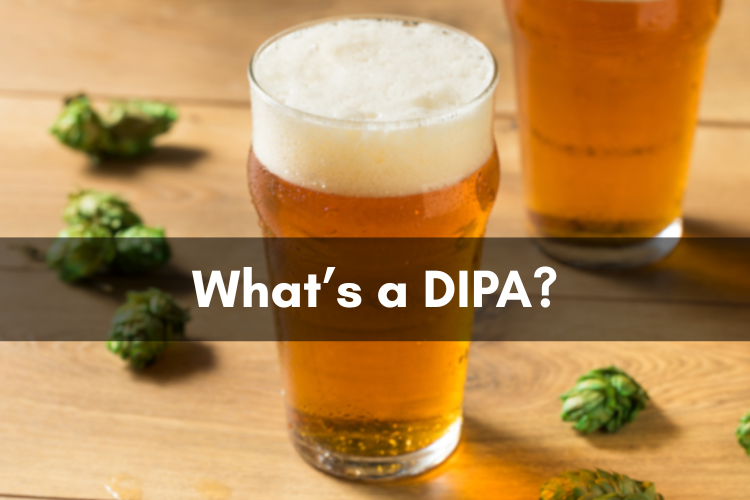
There are a lot of acronyms in beer, ranging from common terms like IPA and ABV to less well-known ones like IBU and DDH. DIPA (sometimes stylized as IIPA) falls somewhere in the middle, since most people visiting a brewery can surmise that it’s a type of IPA, which is correct.
DIPA stands for Double IPA, but if you already knew that, then you’re probably wondering what makes a DIPA different from an IPA. A DIPA is essentially just a bigger, stronger version of a standard IPA, with more hops, more flavor, and more alcohol. You can expect a DIPA to hit around 8-9% ABV, whereas a standard IPA is usually closer to 6-7% ABV.
A Double IPA is more or less just “double.”
How Is a DIPA Different from an IPA?
While a DIPA is essentially just an IPA with more everything, there is a little more nuance to what makes it unique. I actually wrote a full breakdown of IPA vs DIPA if you want to check it out, but here’s the short version.
An IPA is a hop-forward beer. DIPAs leverage that same hop intensity and push it further, but that also means that more malt is needed to reach higher ABVs while keeping the beer balanced. As a result, a DIPA is often thicker, chewier, and more complex than a regular IPA. The best DIPAs are great at hiding just how boozy they are, since the balance of hops and malt should dominate the flavor.
The worst DIPAs taste like a hot, hoppy soup with a boozy burn. Balance is at the center of everything a DIPA is trying to do.
| IPA | DIPA | |
|---|---|---|
| ABV | 5–7% | 7.5–10% |
| IBU | 40–70 | 60–100+ |
| Hop intensity | Moderate to high | High to aggressive |
| Malt presence | Low to moderate | Moderate (to support higher ABV) |
| Body | Medium | Medium to full |
| Best for | Session drinking, nice hop flavor | Slow sipping, strong hop flavor |
West Coast DIPA vs Hazy DIPA
The IPA has famous substyles, and so does the DIPA. Here are some of the main differences between the classic West Coast and Hazy/East Coast DIPA.
West Coast DIPA
People tend to associate DIPA with the West Coast style, likely because the first mainstream DIPAs were produced on the West Coast. A WC DIPA is clear in color, bitter, and leans into the piney, citrusy flavors of hops. While there’s plenty of malt in a WC DIPA, it’s just there to support the ABV and hop flavor.
Pliny the Elder is the textbook example of a West Coast DIPA done well: balanced, crisp, and 8% ABV.
If you know and love West Coast IPAs, think of a West Coast DIPA as the same thing, just dialed up a bit.
Hazy / New England DIPA
A hazy DIPA, sometimes called a New England DIPA, NE DIPA, or East Coast DIPA, is completely different from its West Coast kin. Where West Coast DIPAs are bitter and dry, hazy DIPAs are soft, juicy, and creamy. You’d be forgiven for mistaking a DIPA for orange juice, both in the way it looks and its mouthfeel.
The NE DIPA style has exploded in popularity over the past few years, and a well-made hazy DIPA from somewhere like Tree House or Other Half is one of the best drinking experiences in craft beer. The trade-off is that they’re best when they’re fresh, since the hop aromatics fade quickly. This means that finding a high-quality NE DIPA can be tricky, especially if you don’t live on the East Coast.
If you’ve been loving East Coast IPAs, hazy DIPAs are the next step up in intensity.
Imperial IPA vs DIPA: Is There a Difference?
Another beer style you might see is Imperial IPA. Just to be clear, Imperial IPA, DIPA, Double IPA, and IIPA all refer to the same style. One reason the same style of beer can have so many names is that breweries, beer apps, style guides, and blogs like this all use different terms. BJCP (Beer Judge Certification Program) lists the style as “Double IPA,” while plenty of breweries call them “Imperial.” So, while you could make an argument that there’s an official term for the style, breweries will continue to name beers how they please.
What Does a DIPA Taste Like?
The flavors you can expect from a DIPA depend entirely on the substyle you drink, but in general, expect:
- Hop-forward flavors ranging from citrus (grapefruit, orange) and tropical fruit (mango, passionfruit, guava) to pine, resin, and dank/earthy notes.
- A fuller body than a standard IPA, since the extra malt gives the beer more weight.
- Moderate to high bitterness, with WC DIPAs being more bitter than NE DIPAs.
- A decent alcohol presence that ranges from subtle (in well-made DIPAs) to painfully noticeable (in less balanced ones).
DIPAs Worth Trying
If you’re looking for a DIPA to try, the only real recommendation I can make is Pliny the Elder. The original DIPA, Pliny the Elder is perfectly balanced, complex, and deceptively smooth for 8% ABV. If you can find it, buy it.
Outside of Pliny, the best DIPA you can try is whatever your local craft brewery is offering. Remember that DIPAs rely on strong hop flavor, and that hop flavor starts to vanish pretty quickly. Freshness is everything with a good DIPA, and your local crat brewery will serve it freshest.
DIPA FAQs
DIPA stands for Double India Pale Ale. It’s a stronger, hoppier, and higher-ABV version of a standard IPA, typically ranging from 7.5% to 10% ABV.
Yes, DIPA, Double IPA, Imperial IPA, and IIPA all refer to the same style of beer. Different breweries and beer apps use different names, but they’re interchangeable.
DIPAs can be bitter, but it depends on the substyle. West Coast DIPAs tend to be more bitter, with IBUs often exceeding 70–80. Hazy or New England-style DIPAs have similar hop loads but taste much less bitter because of their softer mouthfeel and residual sweetness.
A Triple IPA (TIPA) is like a DIPA but more, usually above 10% ABV with even more hops and malt. Triple IPAs can be incredible when done well, but they’re also more likely to taste boozy or unbalanced because there’s so much going on in the glass.
DIPAs are calorie-dense compared to lighter beer styles. Expect roughly 250–350 calories per 12 oz serving, depending on the specific beer’s ABV and residual sugar. For comparison, a light beer runs 90–110 calories, and a standard IPA is usually 180–220. If you’re watching calories, you might want to avoid DIPAs.

- 13 Best Light Beers, Ranked - October 7, 2026
- What Is Skunked Beer? (And How to Prevent It) - October 1, 2026
- Best Mexican Beers (That Aren’t Corona) - September 29, 2026