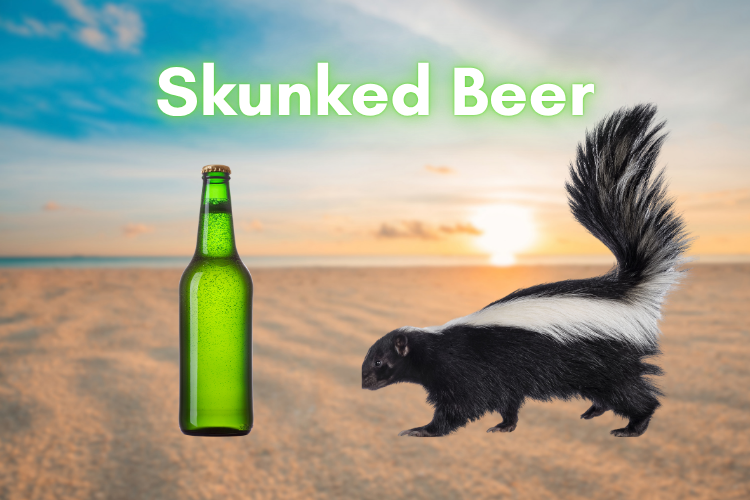
Skunked beer is beer that’s been exposed to light, which then chemically changes the beer. Light exposure breaks down hop compounds into MBT, which is similar to the chemical found in a skunk’s spray. Skunking can happen in just a few minutes, and some beers skunk faster than others (specifically Corona).
What Causes Skunked Beer?
Hops contain alpha acids, which are the main compounds that give beer a bitter flavor. These alpha acids also help protect beer from spoiling, part of the reason why beer can last so long on the shelf, albeit with a big drop-off in flavor and quality.
When sunlight hits alpha acids, the UV splits alpha acids (specifically iso-alpha acids) into fragments. These fragments then bond with sulfur to form 3-methyl-2-butene-1-thiol (MBT). So, instead of having a beer full of delicious, bitter alpha acids, you have a beer with skunk-smelling MBT.
While sunlight can do the most damage to beer, any UV lighting and blue light can affect alpha acids. So, harsh lighting in a store or your home can also lead to skunking.
What Does Skunked Beer Smell and Taste Like?
Skunked beer smells and tastes like a worse version of what you were drinking. While UV breaks down the alpha acids, other ingredients in the beer, like the malt or adjuncts, will remain intact.
Coming from someone who has had to smell skunk spray in the past, skunked beer isn’t as bad, but it isn’t great, either. Expect notes of sulfur and burnt rubber; basically all the worst smells you can run into while driving in a residential area.
If you aren’t sure whether your beer is skunked or not, the best way to tell is by comparing it to a fresh beer that hasn’t been exposed to light. If you don’t have any fresh beer and you think your beer might be skunked, then it’s probably skunked.
Lightstruck Beer and Temperature
Some people believe that beer can skunk if it’s kept at a cold temperature, then warmed to room temperature, put back in the fridge, brought back out, etc. Temperature change won’t skunk beer; only light can skunk beer, which is why skunked beer is also called “lightstruck” beer.
While temperature change won’t skunk your beer, it will ruin it. Heating can speed up oxidation and make your beer go stale faster, even if it’s still in the can or bottle. It’s possible to have a lightstruck and temperature-affected beer, which I can only imagine tastes particularly bad.
Comparing Tastes: Skunked vs. Stale vs. Other Off-Flavors
If your beer tastes wrong and you don’t know why, here’s an easy comparison table.
| Off-Flavor | Cause | Smell/Taste | How Fast | Safe to Drink? |
|---|---|---|---|---|
| Skunked (lightstruck) | Light hitting hop compounds | Skunk, sulfur, burnt rubber | A few minutes in direct sun | Yes |
| Oxidized/stale | Oxygen exposure, sped up by heat and age | Wet cardboard, paper, sherry | Weeks to months | Yes |
| Infected | Bacteria or wild yeast contamination | Sour, vinegar, funky, often overcarbonated | Days to weeks | Generally yes |
| Diacetyl | Fermentation flaw at the brewery | Butter, butterscotch | Present at packaging | Yes |
Why Are Some Beers Sold in Green or Clear Bottles?
The best way to protect beer from UV exposure and skunking is to hide it from light, which is why so many beers are sold in cans or dark brown bottles.
So, why are so many beers sold in green or clear bottles?
Heineken, Stella, and Corona, some of the best-selling beers in the world, all use less-than-optimal packaging. They do this for marketing, since you instinctively know that a clear bottle is probably Corona, and a green bottle with paper on top is probably Stella or Heineken.
Beer brands that ignore skunking do so for one of a few reasons:
- They use modified hop preparation with rho-iso-alpha-acids, which is a special variant that does not lead to skunking.
- They don’t care if their beer is skunked.
I think that Corona follows the second point. Because Corona comes in a clear bottle, there’s almost a guarantee that it’s already skunked or will be after you take it out of the box. But it doesn’t matter, because if all the beer is skunked, then every bottle still has the same, uniform flavor. Also, it’s implied that you’re supposed to add a lime which helps hide the beer’s flavor.
Which Packaging Protects Beer Best?
If you want to avoid skunked beer, cans and kegs are the best choices. If you’re buying bottles, brown glass protects beer from the light best.
When shopping for beer, you can always choose beer that’s sitting further back in the cooler. There’s a good chance it hasn’t been exposed to as much lighting in the store, as some beer could already be skunked just from sitting on the shelves.
FAQs for Skunked Beer
No, skunked beer won’t make you sick, unless you drink enough beer that you would become sick from the alcohol.
No, you can’t fix a skunked beer. Adding a lime to a skunked beer can help hide the beer’s flavor.
A beer can become skunked in just a few minutes of light exposure. Some hardcore beer drinkers will tell you that any light exposure immediately leads to skunking.
Yes, lime hides the skunk in Corona, but why would you buy a beer just to try and hide its flavor?

- What Is Skunked Beer? (And How to Prevent It) - October 1, 2026
- Best Mexican Beers (That Aren’t Corona) - September 29, 2026
- 8 Best Beers for People Who Hate Beer - September 19, 2026