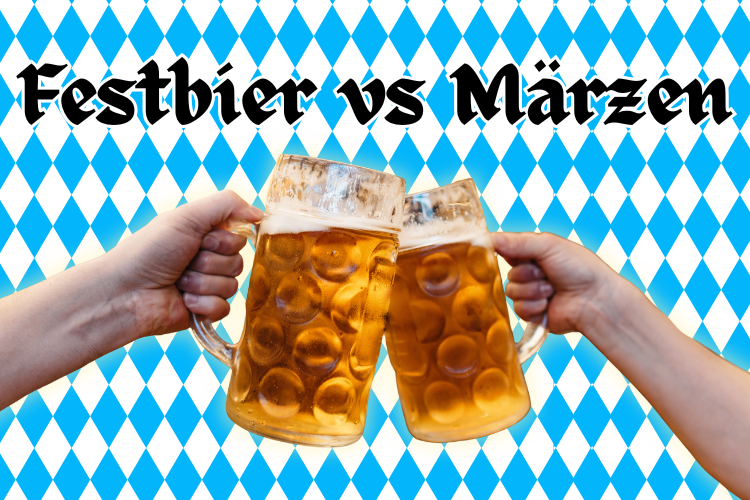
Every fall the beer aisle fills up with seasonal cans sporting the Bavarian flag and Gothic fonts. This is how you know it’s time for Oktoberfest.
Oktoberfest, the annual fall festival held in Munich, is famous worldwide for its lederhosen, giant tents, and beer. Well, mostly the beer. For Oktoberfest fans in the United States, this is the time when we start seeing Märzens and Festbiers line the shelves and fill taproom lists.
So, what’s the difference between the Märzen and Festbier? For starters, Märzen hasn’t been served at the Munich Oktoberfest since the 1970s, and the official beer today is the Festbier. The Festbier is a light, pale lager that you may have never tried, even if you’ve been drinking Oktoberfest beers for years. But both options fall under Reinheitsgebot, the 500-year-old German beer purity law, meaning they’re both brewed with just water, barley, hops, and yeast.
Here’s how the Märzen and Festbier differ, how to tell them apart, and which to drink.
What Is a Märzen?
Märzen is what a lot of people think of as the “classic” German beer. Amber in color, malty with a little bit of sweetness in flavor, the Märzen is a tasty lager that’s usually around 5.5-6.5% ABV. The name comes from März, the German word for March, which is when the beer is brewed. By starting in March, brewers can make sure the perfect Märzen is ready for fall drinking, which lines up perfectly with Oktoberfest.
I love a good Märzen, and they’re pretty easy to find across the US in September and October. I’ll share some of my favorite Märzen picks in a bit, but you can expect a lot of local craft breweries to riff off this style starting in mid-September.
What Is a Festbier?
If you’re going to Oktoberfest in Munich, you’ll almost certainly be drinking Festbier. Festbier (literally “fest” and “beer”) is gold in color, lighter than a Märzen, but still malty enough to carry a nice flavor. While the ABV range is similar to Märzens (usually 5.5%-6% ABV), they’re more sessionable than their amber-colored brethren.
Back in the 1970s, the Big Six breweries of Munich (Augustiner, Hacker-Pschorr, Hofbräu, Löwenbräu, Paulaner, and Spaten) switched from the Märzen to Festbier as the official beer of Oktoberfest. Fortunately, these same breweries distribute their Festbier every year, so you can get an authentic taste of Oktoberfest beer without traveling all the way to Munich.
Best US Märzen and Festbiers to Try
As always, I recommend checking out your favorite craft brewery to see what Oktoberfest beers they’re brewing. But if you want some direction on beers that have great flavor, here are my recommendations:
Märzen Picks
Samuel Adams OctoberFest: This is probably the most widely distributed Oktoberfest beer brewed in the US, so it’s easy to find and the flavor is pretty good.
Leinenkugel’s Oktoberfest: You’ve probably seen this at your grocery store before. Leinenkugel’s Oktoberfest beer is traditional Märzen, though I don’t think it matches the flavor of the Munich beers as well as Sam Adams does.
Wallenpaupack Oktoberfest: This is a regional pick that you should try if you live in or near Pennsylvania. Wallenpaupack’s Oktoberfest is a German-style Märzen with a decoction mash and prominent toasted malt character, and I think it fits the bill really well.
Festbier Picks
There aren’t many great Festbiers brewed in the United States, but you can often find Festbiers from breweries like Hofbräu, Paulaner, Spaten, and the like at beer halls and taphouses. However, I would still recommend:
Sierra Nevada Oktoberfest: Sierra Nevada partners with a different German brewery every year, and recent versions have leaned into Festbier rather than the old-school amber Märzen. This year’s partner is Hoppebräu, and the brew is billed as a modern Festbier.
Märzen vs Festbier: Which Is Best?
| Style | Color | Malt Character | Typical ABV |
|---|---|---|---|
| Märzen | Amber to copper | Toasted bread, caramel, richer body | 5.5-6.5% |
| Festbier | Pale gold | Bready, lighter, cleaner finish | 5.5-6% |
If you’re looking for an authentic Oktoberfest experience, Festbier is the best option. If you’re looking for the best Bavarian beer to drink, it comes down to the brewer more than the style. Both options are built off hundreds of years of brewing history, and both taste great out of a 1L stein. If you can’t find anything from the Big Six of Munich, you should trust whatever’s being served at your favorite watering hold.

- 8 Best Beers for People Who Hate Beer - September 19, 2026
- What Is Single Barrel Whiskey? - September 15, 2026
- Best Tasting Non-Alcoholic Beers For 2026 - September 8, 2026